
Power County Criminal Court Records
A criminal court record is the court clerk's case file after a criminal matter opens. It may begin with a citation, complaint, information, arrest-related filing, or prosecutor charging decision. In Power County, the file can show the defendant, charges, case number, court location, bail or bond, hearings, motions, pleas, disposition, sentence, fines, fees, restitution, probation, and later warrant events if the defendant fails to appear.
Power County criminal records should not be confused with arrest records. Arrest and booking details start with law enforcement and the jail. The court file begins to track what the prosecutor filed and what the court did with those charges. For a closer look at the charge itself, use the Power County arrest records and court charges page; for all civil, family, probate, and traffic records, use the broader Power County court records page.
Idaho's structure is local but unified. Magistrate judges may handle misdemeanor arraignment, trial, sentencing, arrest and search warrant proceedings, initial appearances, bail, and felony preliminary examinations. Felony cases move toward District Court after preliminary proceedings when probable cause and filing posture support that route.
Search Power County Criminal Cases
Use Idaho iCourt Smart Search for public criminal case lookup by name or case number. Use the case-type, status, filing-date, location, and judicial-officer filters to narrow results. Search Hearings can help confirm scheduled criminal hearings, while Make Payments can show eligible balances after court fees have been assessed. Sealed cases and exempt entries will not appear in the public portal.
- Search by case number when known, since it is the most precise criminal record identifier.
- Search by defendant name in Last, First Middle format when the case number is unknown.
- Use Power County as the location filter and apply criminal case-type or date filters when available.
- Review the public case header, docket events, hearing dates, charge information, and disposition data.
- Request documents, certified documents, or FTR audio from the clerk when public summaries are not enough.
Statewide data can supplement the case file. The Idaho Court Case and Charge Data dashboard provides court data context, while criminal-history access and shielding rules are governed by state law. A public case lookup is not the same as a certified background check.
Power County Criminal Case Flow
Criminal court records are easiest to read as a sequence. An arrest, citation, or law-enforcement referral may lead to a prosecutor charging decision. The court file then tracks hearings, pleadings, rulings, and the final outcome. A felony may begin with a first appearance and preliminary examination before District Court proceedings continue. A misdemeanor may be handled in Magistrate Court through arraignment, trial, plea, and sentencing.
Case flow: Charges Filed › Arraignment › Pretrial / Motions › Plea or Trial › Disposition › Sentencing
| Stage | What Happens |
|---|---|
| Charges Filed | The prosecutor files or approves the formal charge that opens the court-side criminal record. |
| Arraignment | The court confirms the charge, plea posture, counsel issue, and release or bail matters. |
| Pretrial / Motions | The parties file requests, exchange information, and prepare for plea, trial, dismissal, or amended charges. |
| Plea or Trial | The case resolves by plea, trial verdict, acquittal, dismissal, or another court-approved outcome. |
| Disposition | The court records the final status of each charge. |
| Sentencing | The record may show jail, prison, probation, fines, fees, restitution, treatment, or other terms. |
Idaho Code 19-2604 relates to withheld judgment and set-aside relief after criminal proceedings.
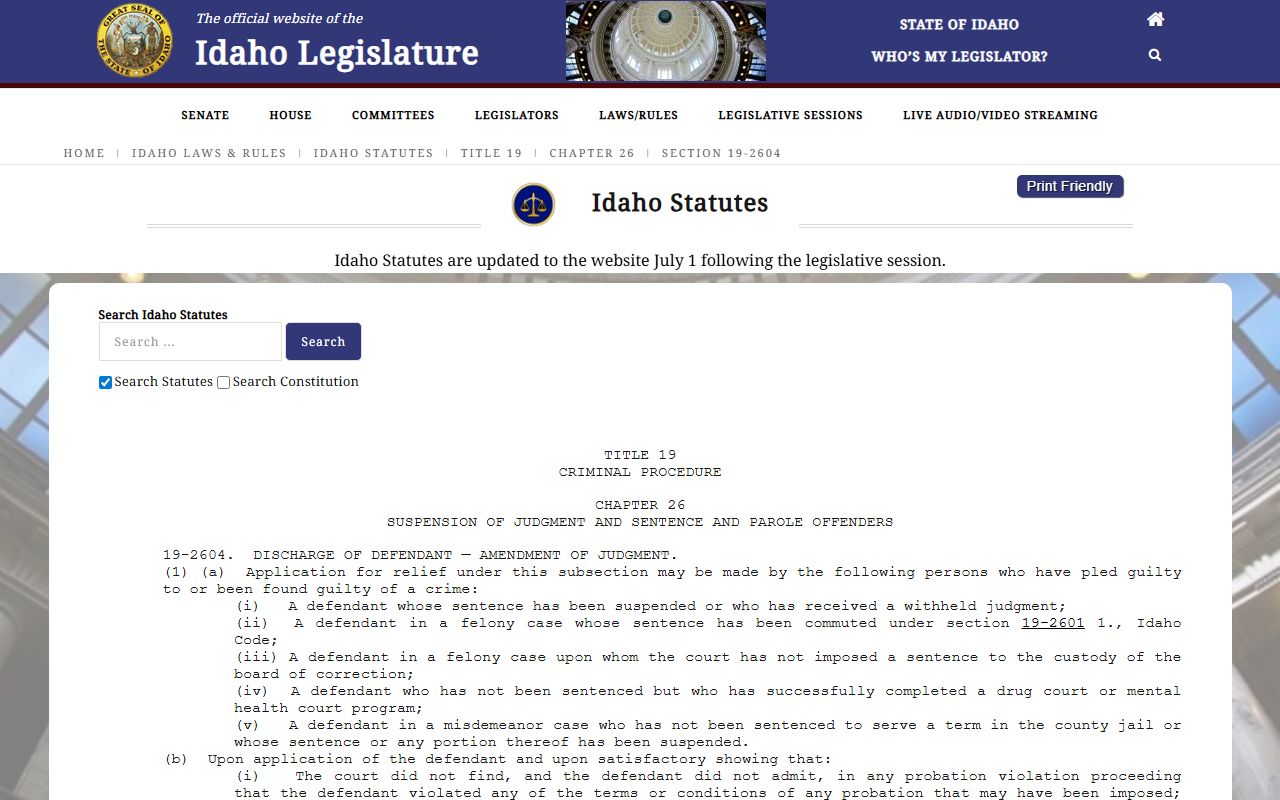
That statute is relevant after a case reaches judgment or sentence, but it does not make every prior arrest, charge, or court event disappear from all systems.
What Power County Criminal Records Show
A Power County criminal court record can contain both summary fields and document-level material. Public iCourt results may show case status and hearing information. The clerk request process is used for copies, certified documents, and audio. Some items, especially sealed, juvenile, or protected information, may be withheld or sent for judge review under Idaho Court Administrative Rule 32.
| Field | What It Shows |
|---|---|
| Case Number | The unique criminal case identifier used in iCourt, payments, and clerk requests. |
| Defendant | The person charged, usually searched in Last, First Middle format. |
| Charges | The filed accusations, which may later be amended, dismissed, reduced, or resolved. |
| Arraignment / Initial Appearance | The early court event where plea, counsel, bail, and notice issues may begin. |
| Bond or Bail | Release terms, bond amount, or later failure-to-appear consequences when public. |
| Motions and Orders | Requests and court rulings that shape the case before final resolution. |
| Plea | The defendant's response, such as guilty or not guilty, if publicly shown. |
| Disposition | The result of each charge, including conviction, dismissal, acquittal, or other outcome. |
| Sentence | Jail, prison, probation, fines, fees, restitution, treatment, or other court terms. |
| Probation / Pretrial Release | Supervision details when included in the case record or related public data. |
Charges vs Convictions
A criminal charge is an accusation filed in court. A conviction is an outcome after a guilty plea, verdict, or other conviction event. A Power County criminal court record may show both charges that led to convictions and charges that were dismissed, reduced, amended, or resolved without conviction. That is why the disposition field matters as much as the charge name.
| Point | Charge | Conviction |
|---|---|---|
| Stage | Filed at or near the start of the court case. | Entered after plea, verdict, or qualifying judgment. |
| Meaning | An accusation the state must prove. | A proven or admitted outcome on a charge. |
| Record Risk | Can remain visible even if later dropped unless restricted. | Can affect sentence, probation, fines, and criminal-history treatment. |
| Best Field | Read charge name, level, and status. | Read disposition, judgment, sentence, and later relief entries. |
Sealed vs Expunged Records
Idaho criminal record relief uses precise terms. The Idaho Clean Slate Act allows eligible records to be shielded from public disclosure after the required period and completion of sentence terms. The research notes a five-year standard from completion of sentence, including probation, parole, fines, and restitution, for eligible nonviolent, non-assaultive offenses. Shielding prevents public access, but it does not destroy the record.
| Point | Sealed or Shielded | Expunged or Set Aside |
|---|---|---|
| Public View | Hidden from public access if the court grants relief or a rule applies. | May change how the record is treated, but relief depends on the statute and case type. |
| Record Existence | The record still exists in court or justice systems. | Idaho relief does not always erase every record in every system. |
| Relevant Sources | Clean Slate Act and Idaho Court Administrative Rule 32. | Idaho Code 67-3004 and Idaho Code 19-2604 may be relevant. |
| Power County Step | Use court forms or clerk review when a case may be shielded or sealed. | Check the exact statute before assuming an arrest, charge, or conviction is gone. |
The official Idaho Supreme Court Clean Slate Act page explains shielding from public disclosure.
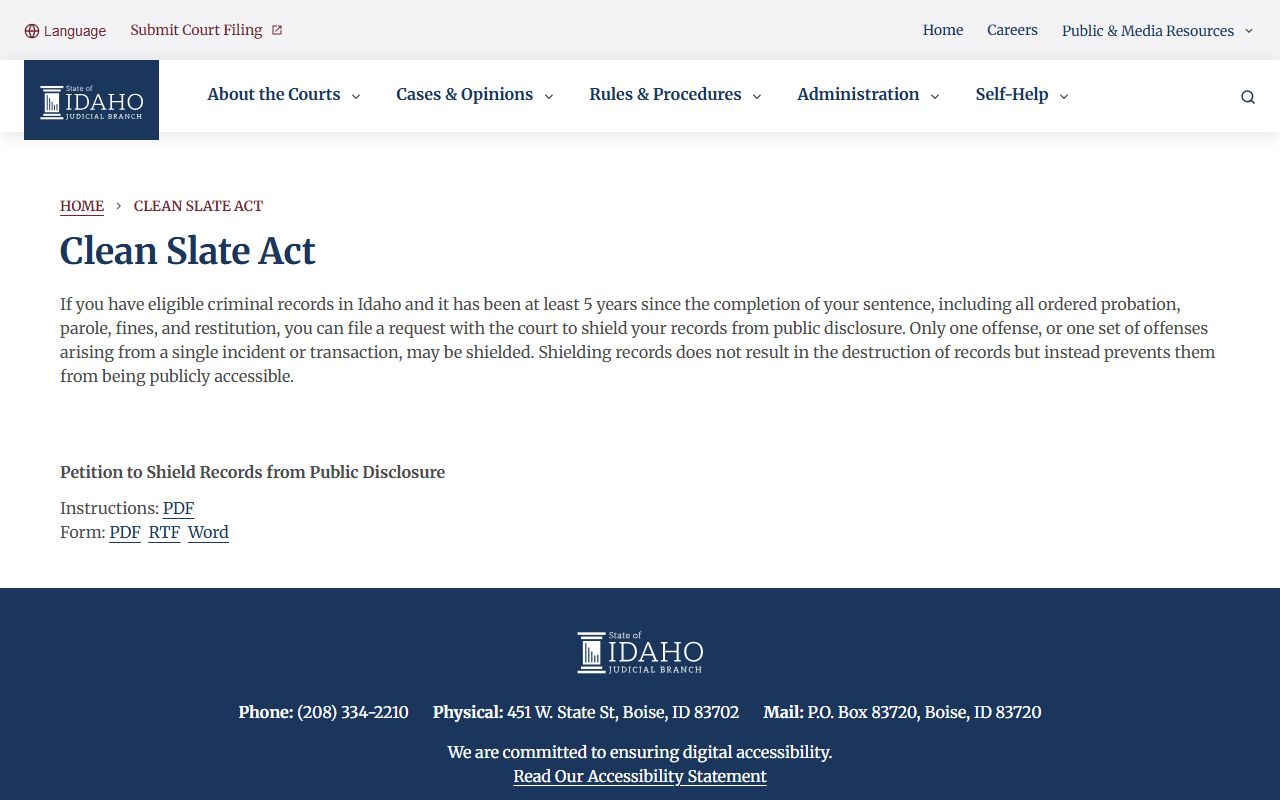
For Power County criminal records, Clean Slate relief is a public-access issue, not proof that no justice-system record ever existed.
Power County Criminal Record Access
Criminal case access is shaped by court rules and public-record statutes. Idaho Court Administrative Rule 32 governs judicial department records. Idaho Code 74-105 covers law-enforcement and investigatory exemptions, which matters when a criminal record request crosses from court case file to police, jail, or prosecutor material. Idaho Code 67-3004 addresses criminal-history records, expungement of certain nonconviction records, and shielding authority.
The local court records request form has a criminal case type checkbox and asks for case number, case name, specific documents, and hearing dates. If the request seeks exempt, sealed, or confidential records, the form requires the reason for request and relation to the case. A public iCourt record can be enough for general lookup, but certified copies come from the clerk.
Idaho Code 67-3004 supports the distinction between court lookup and criminal-history relief.
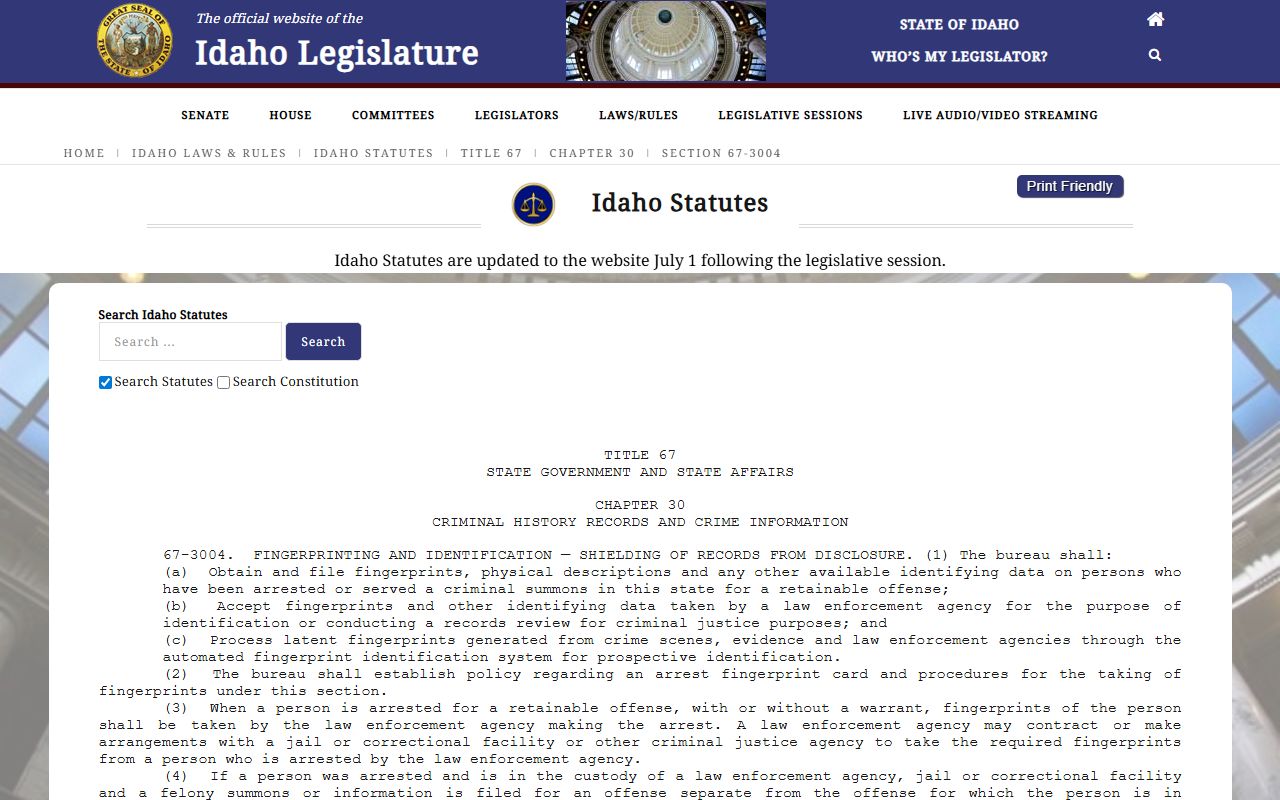
That distinction is important when a search result shows a charge but the user needs to know whether the final history is public, shielded, or otherwise limited.
Restricted Power County Criminal Records
Juvenile criminal matters are not handled like adult cases. The Power County Magistrate Court handles juvenile court, and Idaho's juvenile law helps explain why juvenile court records often have restricted public access. Sealed cases, sealed events, protection-order safety details, mental-health material, personal identifiers, and active investigatory records may also be omitted or redacted.
Idaho Code Title 20, Chapter 5 is relevant to juvenile court restrictions.
Juvenile confidentiality is one reason a public criminal case search may not reflect every court event involving a young person.
Idaho Code 74-105 relates to law-enforcement and investigatory records.
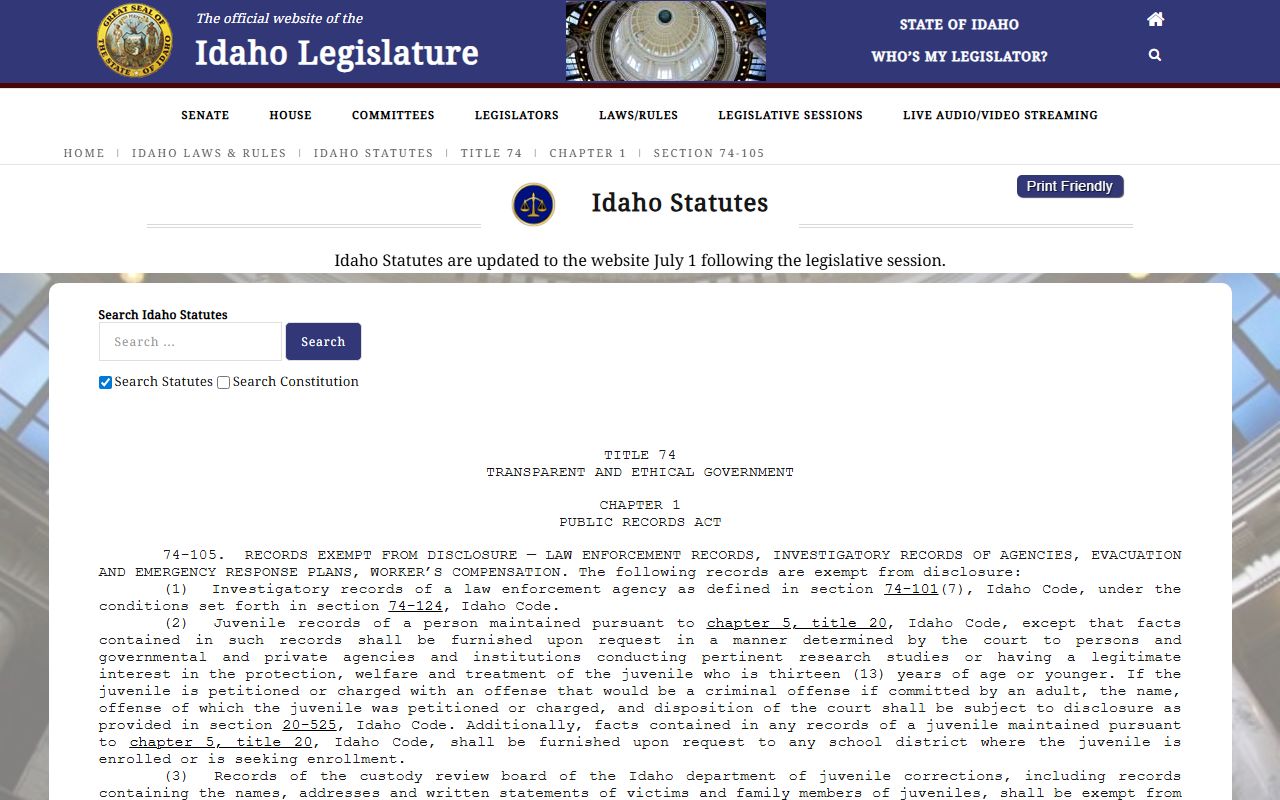
For Power County, that law helps explain why an arrest investigation file and a criminal court case file may have different public-access results.
Power County Criminal Case Offices
The Prosecuting Attorney files and prosecutes felony criminal actions and state-law or county-ordinance misdemeanor or infraction actions when the charging officer is a state or county employee. The office also conducts preliminary criminal examinations before magistrates and draws informations and other charging papers. Public-defense administration changed locally when the Power County Public Defender's Office transitioned to the State Public Defender's Office on October 1, 2024.
Power County Prosecuting Attorney
569 Bannock Ave.
American Falls, ID 83211
208-226-1230
Monday-Friday, 9 a.m.-5 p.m.